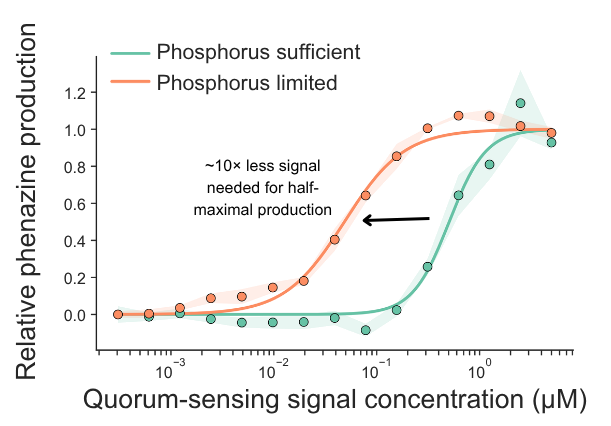
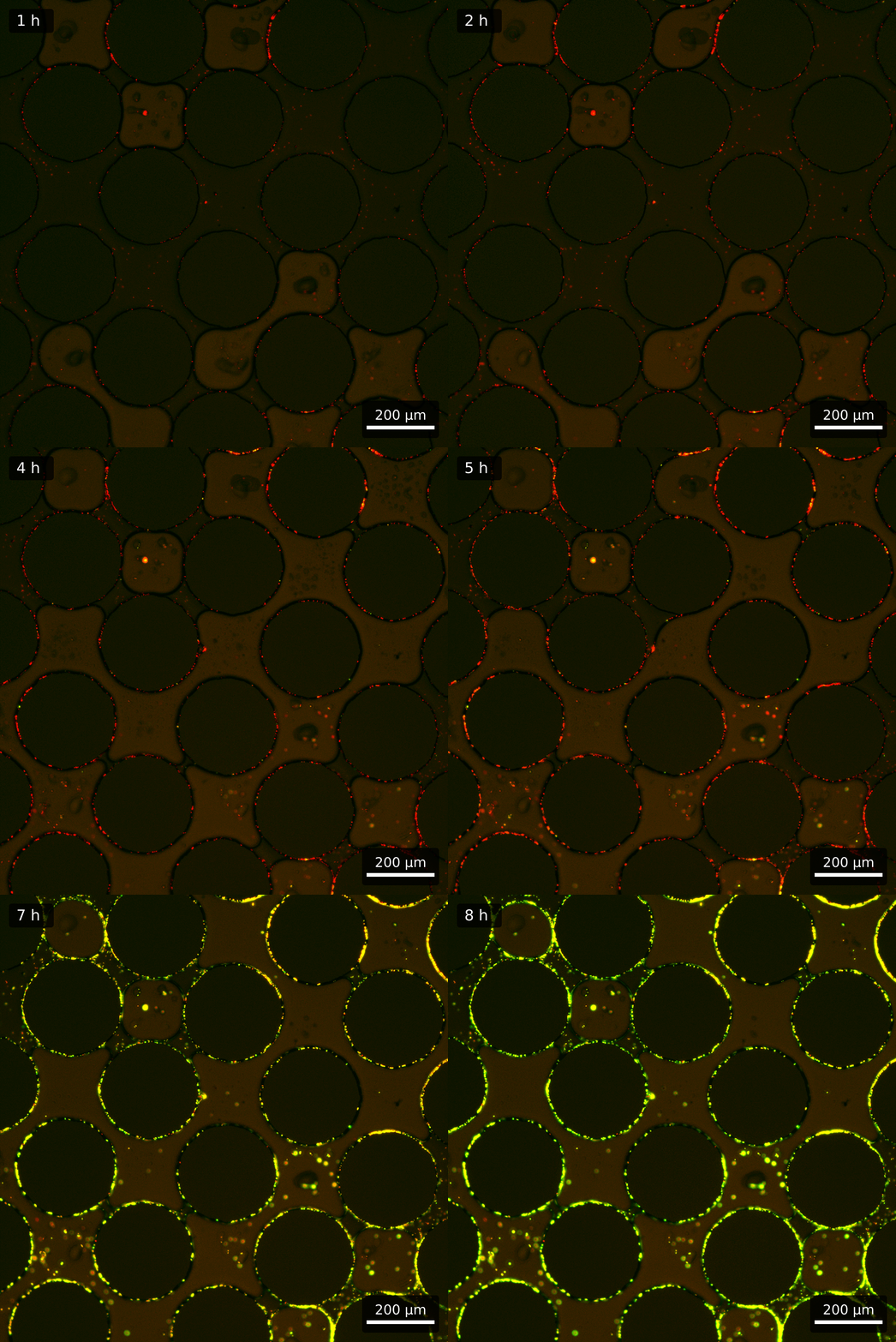
We wanted to understand how bacteria coordinate chemical production when nutrients are scarce and cells occupy small, confined spaces. We found that phosphorus limitation lowered the signal concentration and cell density needed for Pseudomonas synxantha to activate quorum-sensing-dependent phenazine production, while confinement accelerated activation. The study shows that population density alone cannot explain when bacteria activate these behaviors: nutrient stress changes their responsiveness to signals, and confinement changes how quickly signals accumulate.
Phosphorus limitation lowers the signal concentration needed for half-maximal phenazine production by approximately tenfold.P. synxantha fluorescence time-lapse in a porous micromodel, 1–8 h. Red marks constitutively expressed fluorescence; green reports induction of a phenazine biosynthesis gene.
Investigating 3D microbial community dynamics of the rhizosphere using quantitative phase and fluorescence microscopy
Oumeng Zhang†, Reinaldo E. Alcalde†, Haowen Zhou, Siyuan Yin, Dianne K. Newman, Changhuei Yang
Proceedings of the National Academy of Sciences · 2024
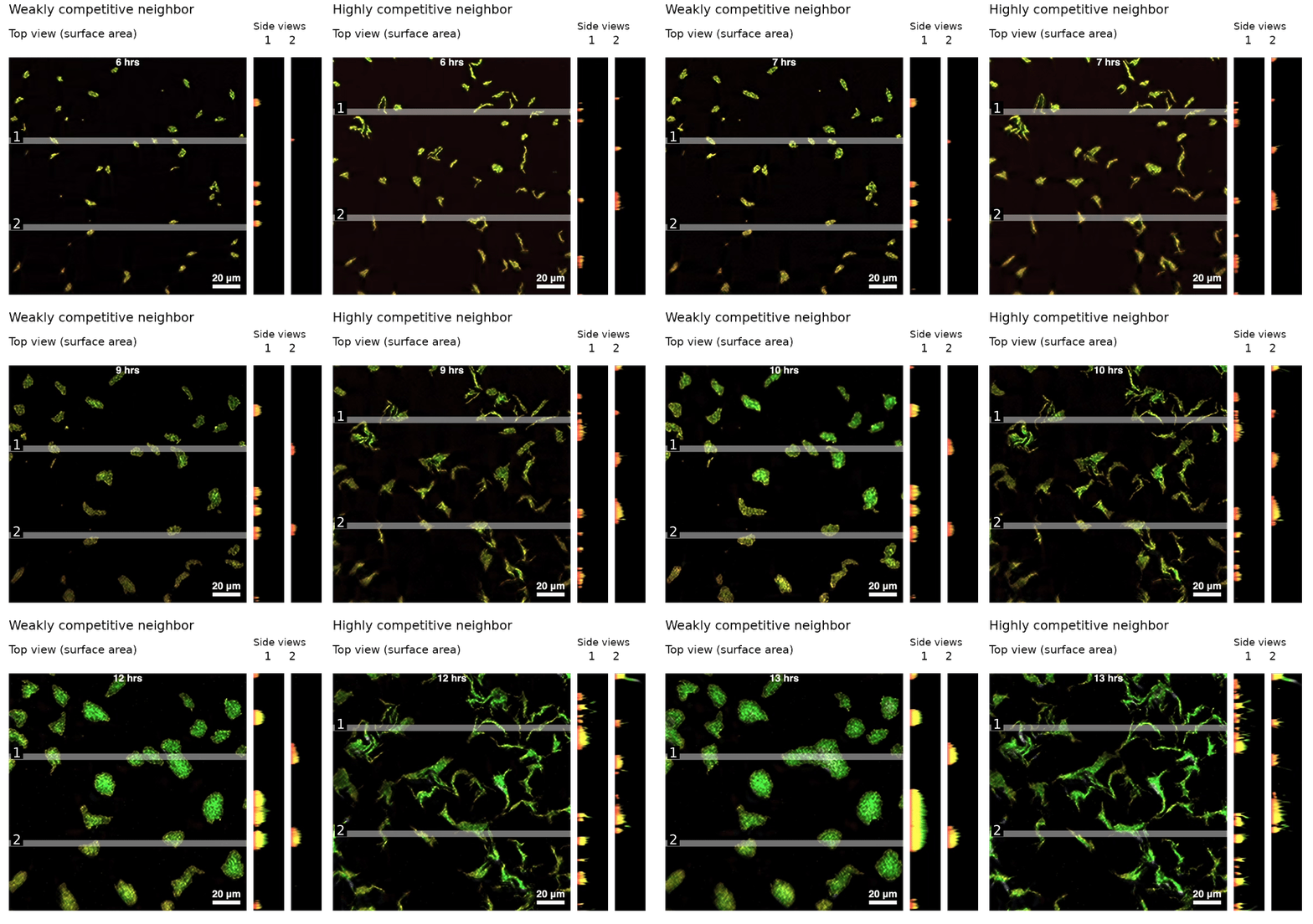
We wanted to watch microbes around roots and in developing biofilms without losing their three-dimensional context. In collaboration with biophotonics experts, we developed CFAST, which combines quantitative phase imaging over a 100 µm depth with 3D fluorescence imaging over a 20 µm depth, without scanning through successive focal planes. We used it to track microbial growth, competition, and gene expression, including the surface expansion and biofilm thickness shown below. We also observed that phosphorus-sensing and antibiotic-production reporters varied across space and time in surface-attached populations, with patterns distinct from those in free-swimming cultures. CFAST made it possible to connect microbial growth and gene expression with three-dimensional community development in experimental systems relevant to the rhizosphere. These observations motivated our subsequent investigation of how nutrient stress and spatial confinement tune quorum sensing.
Three-dimensional growth of Pseudomonas synxantha alongside a weakly competitive strain (left) or a highly competitive strain (right), 6–13 h. Top views show biofilm expansion across the surface. Gray lines mark the locations of the corresponding side views (1 and 2), which reveal biofilm thickness perpendicular to the surface.
The role of chemotaxis and efflux pumps on nitrate reduction in the toxic regions of a ciprofloxacin concentration gradient
Reinaldo E. Alcalde, Christopher M. Dundas, Yiran Dong, Robert A. Sanford, Benjamin Keith Keitz, Bruce W. Fouke, Charles J. Werth
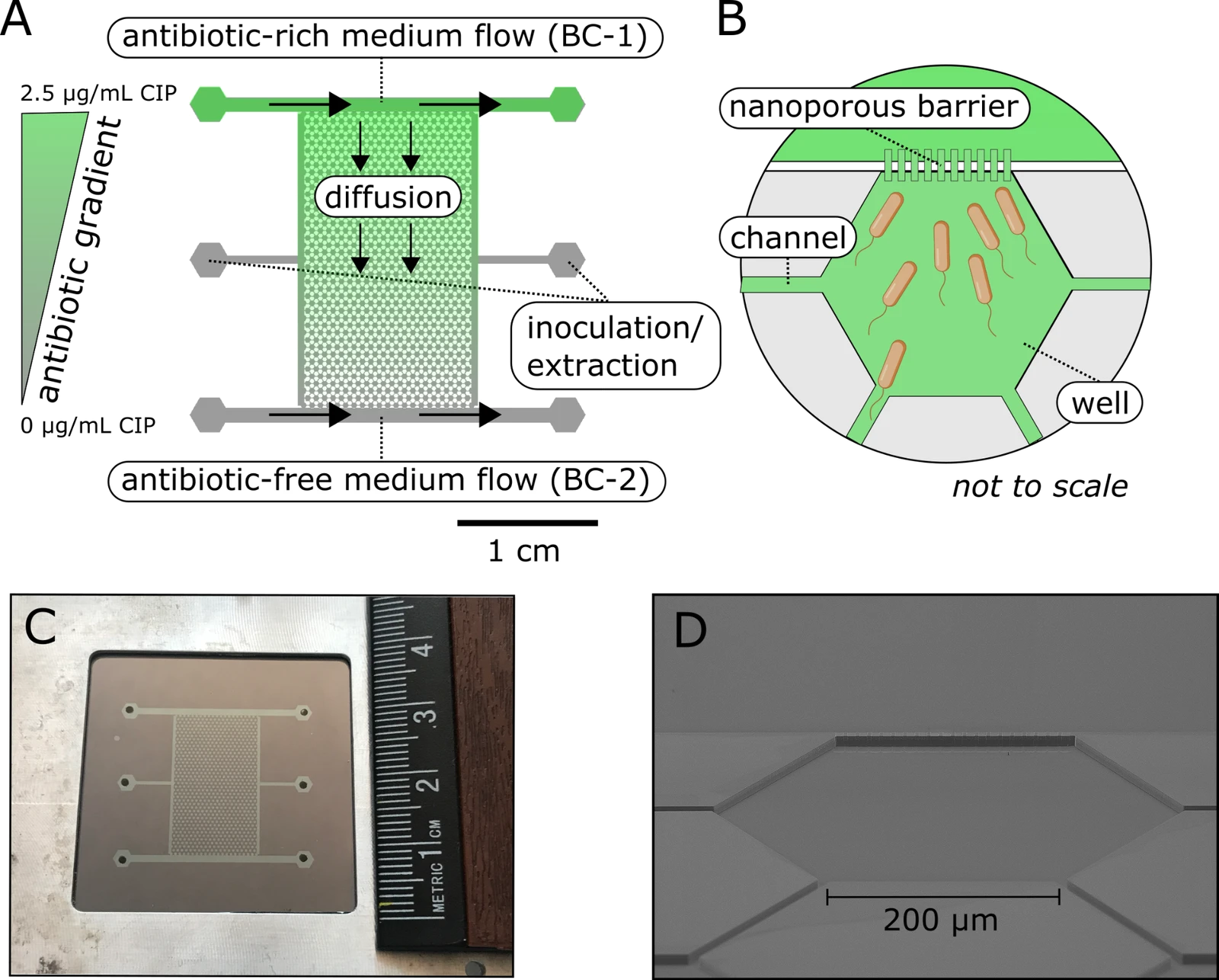
We wanted to understand how antibiotic contamination affects microbial nutrient transformations when antibiotics and nutrients are unevenly distributed. In our earlier ES&T study (2019), we developed microfluidic reactors with controlled chemical gradients and found that swimming Shewanella oneidensis remained active and reduced nitrate in regions containing the bactericidal antibiotic ciprofloxacin at concentrations lethal in well-mixed cultures, without acquiring detectable antibiotic resistance. Nonmotile cells could not sustain the same response.
In this follow-up study, we investigated the mechanisms behind that behavior. Cells unable to navigate chemical gradients showed that chemotaxis toward nitrate was important for sustaining activity in antibiotic-rich regions. Efflux pumps, which export compounds from cells, were important for survival in well-mixed cultures but were not required in the gradients we tested.
The ES&T study established that movement and resource supply can sustain nitrate transformation under antibiotic stress; the ISME study showed that environmental structure can change which cellular mechanisms are required. Together, they demonstrate why uniform-exposure tests alone may not predict microbial activity in contaminated environments.
The microfluidic reactor used to impose controlled antibiotic and nutrient gradients. 800 interconnected wells, each holding 1 nL of fluid.
All publications.
2026
Phosphorus stress and spatial confinement lower the quorum-sensing activation threshold for phenazine production in Pseudomonas synxanthaAlcalde, R. E., Jeckel, H., Zhang, O., Avila, R., Dalleska, N., Mavrodi, D., Yang, C., Newman, D. K.Current Biology10.1016/j.cub.2026.05.044
Drought drives elevated antibiotic resistance across soilsShan, X., Cao, K., Jeckel, H., Alcalde, R. E., Trindade, I., Kwiecinski, J., Newman, D. K.Nature Microbiology10.1038/s41564-026-02274-x
A 65nm CMOS hydrogel-based dual fluorescence sensor for bioavailable phosphorus detectionCheng, T.-Y., Mukkamala, R. S., Alcalde, R. E., Panahandeh, M., Agarwal, A., Kornfield, J. A., Newman, D. K., Emami, A.IEEE International Solid-State Circuits Conference10.1109/ISSCC49663.2026.11409129
Analytic Fourier ptychotomography for aberration-free and high-resolution volumetric refractive index imagingDong, Z., Zhou, H., Cao, R., Zhang, O., Zhao, S., Lyu, P., Alcalde, R. E., Yang, C.Nature Communications10.1038/s41467-025-67460-7
2025
Single-shot volumetric fluorescence imaging with neural fieldsZhang, O., Zhou, H., Feng, B. Y., Larsson, E. M., Alcalde, R. E., Yin, S., Deng, C., Yang, C.Advanced Photonics10.1117/1.AP.7.2.026001
Modeling the migration and growth of Shewanella oneidensis MR-1 in a diffusion-dominated microfluidic gradient chamber under the influence of an antibiotic concentration gradientEsfahani, S. G., Alcalde, R. E., Valocchi, A. J., Sanford, R. A., Werth, C. J.Biotechnology and Bioengineering10.1002/bit.28991
2024
Investigating 3D microbial community dynamics of the rhizosphere using quantitative phase and fluorescence microscopyZhang, O.†, Alcalde, R. E.†, Zhou, H., Yin, S., Newman, D. K., Yang, C.Proceedings of the National Academy of Sciences10.1073/pnas.2403122121† Equal contribution
2022
Sulfate-reducing bacteria streamers and iron sulfides abruptly occlude porosity and increase hydraulic resistance in proppant-filled shale fracturesFouke, B. W., Bhattacharjee, A. S., Fried, G. A., Sivaguru, M., Sanford, R. A., Zhou, L., Alcalde, R. E., Wunch, K., Stephenson, A., Ferrar, J. A., Hernandez, A. G., Wright, C., Fields, C. J., Todorov, L. G., Fouke, K. W., Bailey, C. M., Werth, C. J.AAPG Bulletin10.1306/07132120124
2021
The role of chemotaxis and efflux pumps on nitrate reduction in the toxic regions of a ciprofloxacin concentration gradientAlcalde, R. E., Dundas, C. M., Dong, Y., Sanford, R. A., Keitz, B. K., Fouke, B. W., Werth, C. J.The ISME Journal10.1038/s41396-021-00975-1
Impact of antibiotic concentration gradients on nitrate reduction and antibiotic resistance in a microfluidic gradient chamberZhou, L., Alcalde, R. E., Deng, J., Zuniga, B., Sanford, R. A., Fouke, B. W., Werth, C. J.Science of the Total Environment10.1016/j.scitotenv.2021.146503
2019
Adaptive evolution of Escherichia coli to ciprofloxacin in controlled stress environments: Contrasting patterns of resistance in spatially varying versus uniformly mixed concentration conditionsDeng, J., Zhou, L., Sanford, R. A., Shechtman, L. A., Dong, Y., Alcalde, R. E., Sivaguru, M., Fried, G. A., Werth, C. J., Fouke, B. W.Environmental Science & Technology10.1021/acs.est.9b00881
Diffusion-based recycling of flavins allows Shewanella oneidensis MR-1 to yield energy from metal reduction across physical separationsMichelson, K., Alcalde, R. E., Sanford, R. A., Valocchi, A. J., Werth, C. J.Environmental Science & Technology10.1021/acs.est.8b04718
Motility of Shewanella oneidensis MR-1 allows for nitrate reduction in the toxic region of a ciprofloxacin concentration gradient in a microfluidic reactorAlcalde, R. E., Michelson, K., Zhou, L., Schmitz, E. V., Deng, J., Sanford, R. A., Fouke, B. W., Werth, C. J.Environmental Science & Technology10.1021/acs.est.8b04838
2018
Geobiology reveals how human kidney stones dissolve in vivoSivaguru, M., Saw, J. J., Williams, J. C., Lieske, J. C., Krambeck, A. E., Romero, M. F., Chia, N., Schwaderer, A. L., Alcalde, R. E., Bruce, W. J., Wildman, D. E., Fried, G. A., Werth, C. J., Reeder, R. J., Yau, P. M., Sanford, R. A., Fouke, B. W.Scientific Reports10.1038/s41598-018-31890-9
An environmental science and engineering framework for combating antimicrobial resistancePruden, A., Alcalde, R. E., Alvarez, P. J. J., Ashbolt, N., Bischel, H., Capiro, N. L., Crossette, E., Frigon, D., Grimes, K., Haas, C. N., Ikuma, K., Kappell, A., LaPara, T., Kimbell, L., Li, M., Li, X., McNamara, P., Seo, Y., Sobsey, M. D., Sozzi, E., Navab-Daneshmand, T., Raskin, L., Riquelme, M. V., Vikesland, P., Wigginton, K., Zhou, Z.Environmental Engineering Science10.1089/ees.2017.0520
Perceived versus actual water quality: Community studies in rural Oaxaca, MexicoRowles, L. S., Alcalde, R., Bogolasky, F., Kum, S., Diaz-Arriaga, F. A., Ayres, C., Mikelonis, A. M., Toledo-Flores, L. J., Alonso-Gutiérrez, M. G., Pérez-Flores, M. E., Lawler, D. F., Ward, P. M., Lopez-Cruz, J. Y., Saleh, N. B.Science of the Total Environment10.1016/j.scitotenv.2017.11.309